import pandas as pd
import numpy as np
import matplotlib.pyplot as plt
from sklearn.preprocessing import StandardScaler

np.random.seed(1)

import warnings
warnings.filterwarnings('ignore')Lecture 2b - Supervised Learning
Data
We consider the Kings County housing dataset. It includes homes sold between May 2014 and May 2015.
Specifically, we focuse on the Rainier Valley zipcode.
# Load the dataset
house = pd.read_csv("data/rainier_valley_house.csv")
Here are the features:
house.columnsIndex(['Unnamed: 0', 'id', 'date', 'price', 'bedrooms', 'bathrooms',
'sqft_living', 'sqft_lot', 'floors', 'waterfront', 'view', 'condition',
'grade', 'sqft_above', 'sqft_basement', 'yr_built', 'yr_renovated',
'zipcode', 'lat', 'long', 'sqft_living15', 'sqft_lot15'],
dtype='object')# number of houses
print(f"number of houses: {house.shape[0]}")
plt.boxplot(house['price'])
plt.title('Price Boxplot')
# make plot small in jupyter output
plt.gcf().set_size_inches(4, 3)
plt.show()number of houses: 508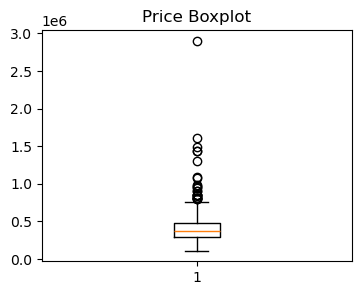
## For houses with 0, 1, 2, ... bedrooms, show their median price
print(house.groupby('bedrooms')['price'].median().reset_index())
bedrooms price
0 0 228000.0
1 1 299000.0
2 2 325000.0
3 3 365000.0
4 4 447500.0
5 5 425000.0
6 6 462500.0
7 7 370500.0# Filtering houses priced under 1 million
house = house[house['price'] < 1e6]## Plot year built vs. price
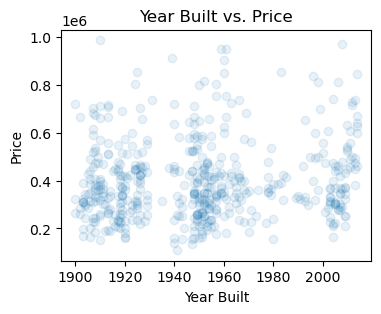
plt.scatter(house['yr_built'], house['price'], alpha=0.1)
plt.xlabel('Year Built')
plt.ylabel('Price')
plt.title('Year Built vs. Price')
plt.gcf().set_size_inches(4, 3)
plt.show()
## Smooth scatter plot of year built vs. price
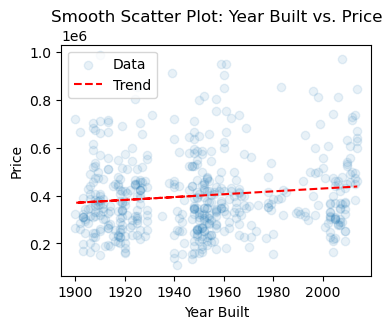
plt.scatter(house['yr_built'], house['price'], alpha=0.1, label='Data')
z = np.polyfit(house['yr_built'], house['price'], 1)
p = np.poly1d(z)
plt.plot(house['yr_built'], p(house['yr_built']), "r--", label='Trend')
plt.xlabel('Year Built')
plt.ylabel('Price')
plt.title('Smooth Scatter Plot: Year Built vs. Price')
plt.legend()
plt.gcf().set_size_inches(4, 3)
plt.show()
## Plot year built vs. sqft_living
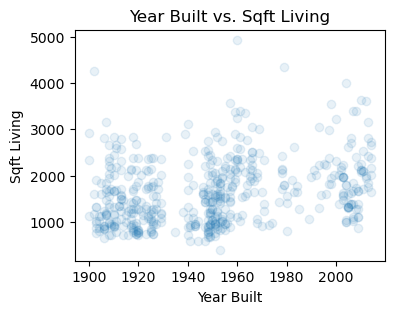
plt.scatter(house['yr_built'], house['sqft_living'], alpha=0.1)
plt.xlabel('Year Built')
plt.ylabel('Sqft Living')
plt.title('Year Built vs. Sqft Living')
plt.gcf().set_size_inches(4, 3)
plt.show()
## Pairwise plot of price, bedrooms, and sqft_living
#pd.plotting.scatter_matrix(house[['price', 'bedrooms', 'sqft_living']], alpha=0.1, figsize=(10, 10))
#plt.show()
## Group by condition and calculate mean price
print(house.groupby('condition')['price'].mean().reset_index())
condition price
0 1 227000.000000
1 2 246749.705882
2 3 396841.120482
3 4 420201.384615
4 5 433258.152174plt.figure(figsize=(10, 8))
sc = plt.scatter(house['long'], house['lat'], c=house['price'], cmap='viridis', alpha=0.5)
plt.colorbar(sc, label='Price ($)')
plt.xlabel('Longitude')
plt.ylabel('Latitude')
plt.title('House Location and Price')
plt.gcf().set_size_inches(5, 4)
plt.show()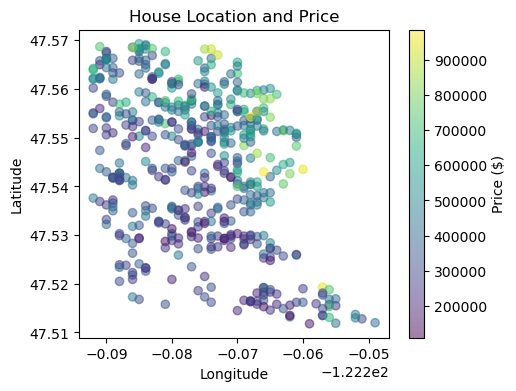
K-Nearest Neighbors
# We will consider this subset of features
features = ["floors", "grade", "condition", "view", "sqft_living",
            "sqft_lot", "sqft_basement", "yr_built", "yr_renovated",
            "bedrooms", "bathrooms", "lat", "long"]

Y = house['price'] / 1000
X = house[features]

## Standardize the features
scaler = StandardScaler()
X_stan = scaler.fit_transform(X)

## Split the data into training and test sets
n_train = 400
n_test = 100

idx = np.random.permutation(len(Y))
X_stan = X_stan[idx]
Y = Y.iloc[idx]

X_train = X_stan[:n_train]
X_test = X_stan[n_train:(n_train + n_test)]
Y_train = Y[:n_train]
Y_test = Y[n_train:n_train + n_test]

## Implement KNN
K = 7
Y_pred = []

for test_point in X_test:
    distances = np.sqrt(((X_train - test_point)**2).sum(axis=1))
    nearest_neighbors_indices = distances.argsort()[:K]
    Y_pred.append(Y_train.iloc[nearest_neighbors_indices].mean())

Y_pred = np.array(Y_pred)
Y_pred_baseline = Y_train.mean()

# Evaluate test error
test_error = np.sqrt(((Y_test - Y_pred) ** 2).mean())
baseline_error = np.sqrt(((Y_test - Y_pred_baseline) ** 2).mean())
print(f"Test RMSE of KNN: {test_error:.3f}   Baseline RMSE: {baseline_error:.3f}")

#print test R-squared
R2 = 1 - test_error**2 / baseline_error**2
print(f"Test R-squared of KNN: {R2:.3f}")
Test RMSE of KNN: 130.075 Baseline RMSE: 186.689
Test R-squared of KNN: 0.515from sklearn.model_selection import train_test_split
from sklearn.neighbors import KNeighborsRegressor
# Split the data into training and test sets
X_train, X_test, Y_train, Y_test = train_test_split(X_stan, Y, test_size=100, train_size=400, random_state=1)
train_errs = []
test_errs = []
for K in range(1, 30):
knn = KNeighborsRegressor(n_neighbors=K)
knn.fit(X_train, Y_train)
Y_train_pred = knn.predict(X_train)
Y_pred = knn.predict(X_test)
# Evaluate test error
train_error = np.sqrt((Y_train - Y_train_pred) ** 2).mean()
test_error = np.sqrt(((Y_test - Y_pred) ** 2).mean())
train_errs.append(train_error)
test_errs.append(test_error)
plt.plot(range(1, 30), train_errs, marker='o', label='train error')
plt.plot(range(1, 30), test_errs, marker='o', label='test error')
plt.legend()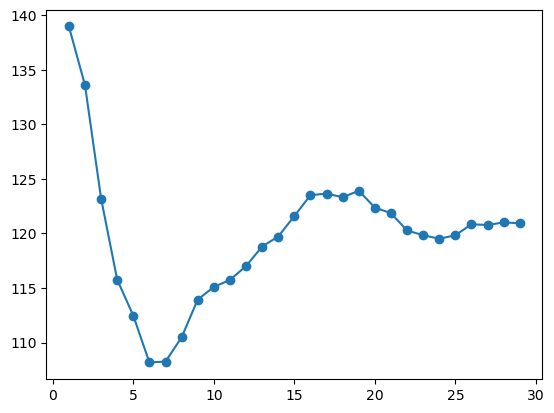
The test error is minimized at K=3.